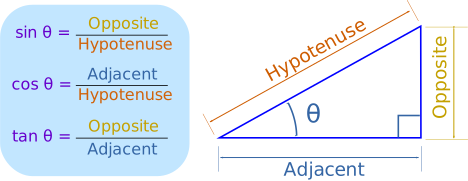
Sine, Cosine and Tangent are the main functions used in Trigonometry and are based on a Right-Angled Triangle. Before getting stuck into the functions, it helps to give a name to each side of a right triangle: Opposite is always opposite the angle. And Adjacent is always next to the angle.
The cosine is a fundamental trigonometric function such that the cosine of an angle of a right triangle is the ratio of its adjacent side to the hypotenuse.
Cosine, written as cos (θ), is one of the six fundamental trigonometric functions. There are two main ways in which trigonometric functions are typically discussed: in terms of right triangles and in terms of the unit circle.
Easily calculate sine, cosine, tangent, cosecant, secant, and cotangent values for any angle in degrees or radians with our free online trigonometric functions calculator.
Sine and cosine, denoted as sin (θ) and cos (θ), are fundamental trigonometric functions that associate each angle, defined from the unit circle, with a value between -1 and +1.
The cosine function, along with sine and tangent, is one of the three most common trigonometric functions. In any right triangle, the cosine of an angle is the length of the adjacent side (A) divided by the length of the hypotenuse (H). In a formula, it is written simply as 'cos'.
Cosine definition In a right triangle ABC the cosine of α, cos (α) is defined as the ratio betwween the side adjacent to angle α and the side opposite to the right angle (hypotenuse):
This page explains the sine, cosine, tangent ratio, gives on an overview of their range of values and provides practice problems on identifying the sides that are opposite and adjacent to a given angle.